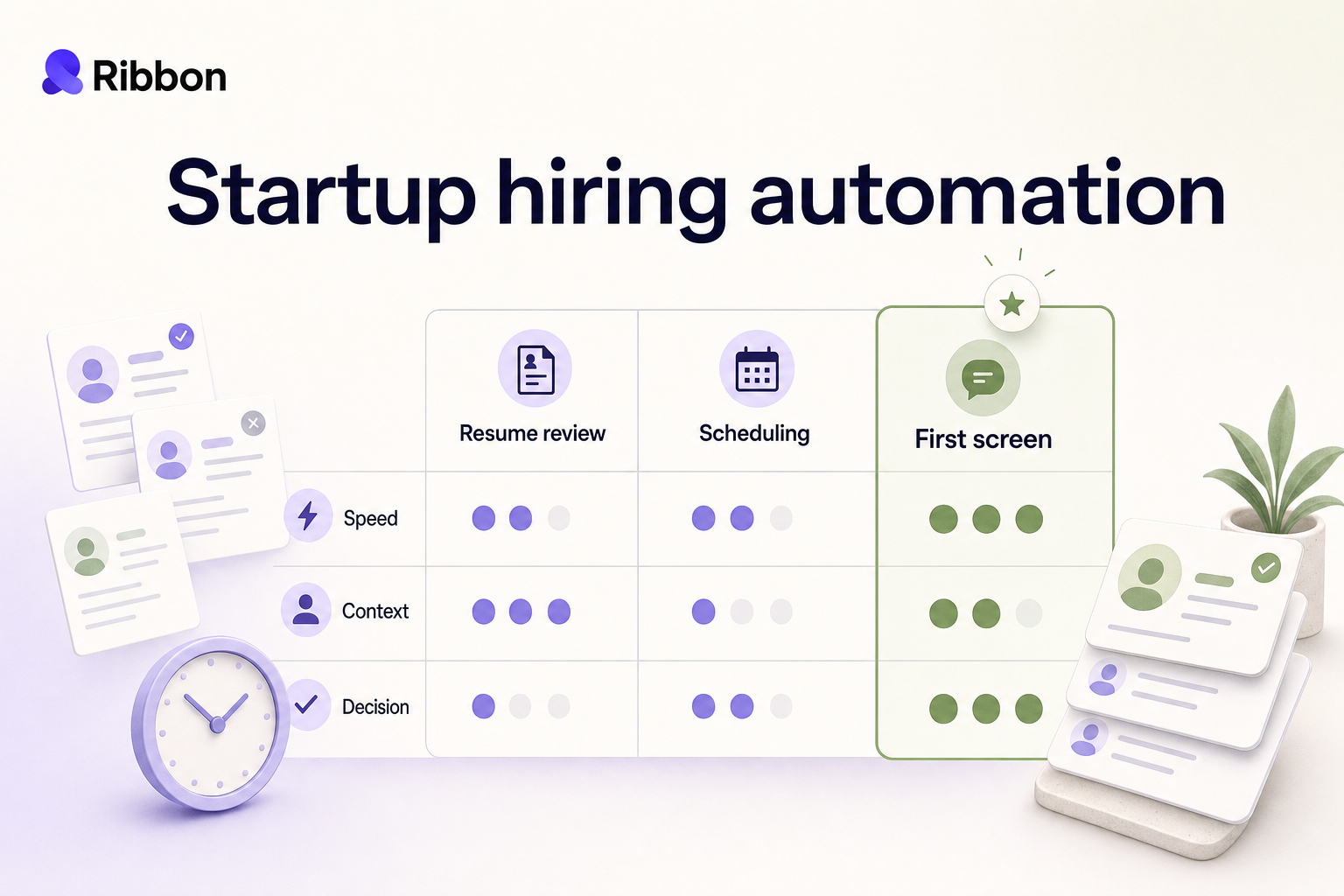
Most small hiring teams automate scheduling first because it is easy to bolt on. The better first move is usually the first screen, where transcripts, recordings, scores, and ATS context actually reduce decision time.
Lorem ipsum dolor sit amet, consectetur adipiscing elit, sed do eiusmod tempor incididunt ut labore et dolore magna aliqua. Ut enim ad minim veniam, quis nostrud exercitation ullamco laboris nisi ut aliquip ex ea commodo consequat. Duis aute irure dolor in reprehenderit in voluptate velit esse cillum dolore eu fugiat nulla pariatur.
Block quote
Ordered list
Unordered list
Bold text
Emphasis
Superscript
Subscript
If you run hiring with one recruiter, a founder, and a few busy hiring managers, "automation" can turn into a shopping spree. There is always another tool that promises faster scheduling, better sourcing, cleaner notes, or less admin work. The problem is not finding something you can automate. The problem is picking the first workflow that actually changes hiring speed.
Small teams often start at the edge of the process. They automate interview scheduling. They add a sourcing tool. They install a chatbot on the career page. Those can help, but they rarely remove the real bottleneck. In most lean hiring teams, the real bottleneck is the first screen: the repeated conversation, the note-taking, the back-and-forth, and the slow handoff into the ATS.
If I had to choose one workflow to automate first, I would start there. Not because it sounds flashy, but because it is where you finally get reusable hiring evidence instead of another calendar event.
Scheduling is attractive because it is easy to understand. A candidate picks a time, a calendar invite goes out, and the team feels more organized. Sourcing tools are attractive for the same reason. They promise more pipeline. Both categories can be useful, especially when a team is already humming.
But early-stage or lean recruiting teams usually do not lose most of their time on calendar links. They lose it in the messy middle between application and shortlist. Someone has to reach out. Someone has to screen. Someone has to listen for red flags, write notes, compare candidates, and explain the recommendation to the next reviewer. That work repeats for every role, every week.
Automating the edges while leaving the first screen manual creates a strange result: more activity, same decision delay. You may book interviews faster or collect more applicants, but your team still waits on the same human bottleneck before anyone can move to the next stage.
The first screen sits at the point where candidate experience, recruiter time, and hiring quality all collide. When it stays manual, every gain upstream or downstream gets muted. When it improves, the whole funnel moves better.
That last point matters more than people think. Small teams do not need automation for its own sake. They need evidence that helps the next decision happen faster. A recorded screening conversation with a tight summary is far more useful than another pile of resumes waiting for someone to review them after dinner.
This is also where Ribbon's product shape fits the job. Ribbon's live product surface is built around AI interviews that run around the clock, structured scoring, and ATS-connected review. On the public site, Ribbon positions the product for high-volume teams but also prices a Growth plan for "small but mighty teams," with ATS integrations included even at that entry tier. That matters for lean companies because the best early automation is usually the one that fits into the system you already use.
This is the line I would use when evaluating any hiring automation for a small team: after the workflow runs, what lands back in the candidate record, and is it enough for the next person to make a call?
The answer should be concrete. A good first-screen workflow should leave your team with:
Ribbon's current product and code surface supports several pieces of that operating model. Teams can map ATS jobs and stages, save custom scores for an interview flow, export candidate data, generate transcript-based follow-up questions, and revoke access to interview recordings when needed. Interview settings also expose controls for consent text, phone collection, and desktop requirements. Those details are not trivia. They are the difference between "we tried an AI tool" and "we built a repeatable screening step that ops can trust."
There is also a buyer-side question hiding underneath all of this: does the tool keep your ATS at the center, or does it create a second source of truth? Ribbon's public product pages lean hard into ATS-connected workflows, including integrations and sourcing pages that frame profiles, recordings, and scores as things your team can review in the systems they already use. For a lean team, that is the right instinct. The moment automation creates a parallel workflow, the admin work comes right back.
Good hiring automation should narrow the field and improve the handoff. It should not pretend to make the final decision for you.
Ribbon's privacy policy is refreshingly direct on this point. The company says its tools may generate transcripts, summaries, scores, or insights, but it does not make autonomous hiring or employment decisions. That is the right boundary for a small team too. Let the system handle repeatable screening steps. Keep humans in charge of exceptions, calibration, closing, and anything that requires judgment about context.
In practice, that usually means:
That is not a limitation. It is the model. Small teams move faster when the machine does the repetition and the team spends its energy where judgment counts.
If you are choosing your first hiring automation project, keep the scope boring. Boring wins.
Only after that would I expand into more sourcing, more outreach channels, or more workflow branches. Small teams get into trouble when they automate five things at once and cannot tell which one improved the funnel. Start with the first screen, get the review loop tight, and build outward from there.
That is the practical case for first-screen automation. It is not the flashiest category in recruiting tech, but it is the one most likely to give a lean hiring team a faster shortlist without adding another layer of process. If your automation does not leave the ATS clearer, the next reviewer faster, and the decision more grounded, it is probably solving the wrong problem first.
Related reading: Ribbon integrations, pricing for small and scaling teams, how sourcing fits the stack, and Ribbon's privacy policy.
Natural-sounding AI interviews that candidates actually enjoy
Instant feedback and scoring for every candidate
24/7 availability. Never lose a candidate to scheduling delays

"Ribbon AI reduced our time-to-hire by 60% while improving candidate experience."
- Sarah M., Head of Talent
See why teams are switching to smarter hiring.
7-day free trial • Cancel anytime


