Home care teams lose good caregivers in the gap between application and first callback. This pilot blueprint shows how to test AI screening on one live role, keep consent and ATS handoff clean, and give schedulers a review packet they can act on fast.
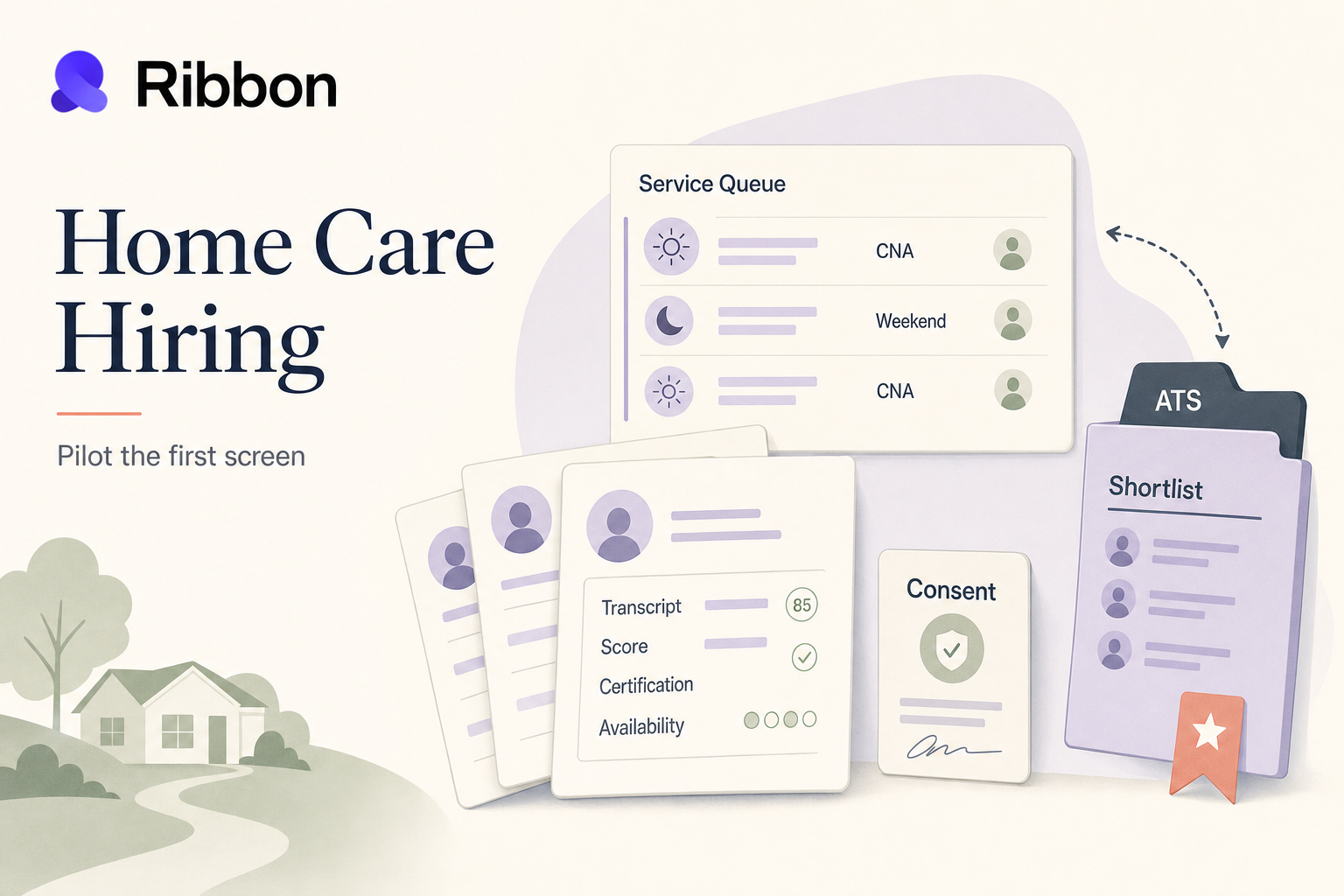
Lorem ipsum dolor sit amet, consectetur adipiscing elit, sed do eiusmod tempor incididunt ut labore et dolore magna aliqua. Ut enim ad minim veniam, quis nostrud exercitation ullamco laboris nisi ut aliquip ex ea commodo consequat. Duis aute irure dolor in reprehenderit in voluptate velit esse cillum dolore eu fugiat nulla pariatur.
Block quote
Ordered list
Unordered list
Bold text
Emphasis
Superscript
Subscript
Home care hiring rarely breaks because agencies have no demand. It breaks because the strongest caregivers apply outside office hours, reply to several agencies in one sitting, and take the first serious response that sounds organized. By the time a scheduler gets to the callback queue the next morning, the best applicant may already be gone.
That is why a home care pilot needs to focus on response time and review quality, not on flashy automation claims. If the first screen happens faster, captures the right evidence, and lands inside the team's existing workflow, the pilot is useful. If it creates another dashboard, another cleanup step, or another compliance question, it dies before rollout.
Ribbon's home care page frames the operating problem well: caregivers apply late, interviews often happen at night or on weekends, and schedulers need scored profiles before the next huddle. The public workflow and the local product surface point to a practical pilot shape: connect one role to the ATS, screen every applicant immediately, keep the review packet tight, and make it obvious what still belongs to a human.
Here is how I would run that pilot.
The fastest way to lose a home care pilot is to start with every role, every branch, and every exception case at once. Home care has too many operational variables for that. Availability matters. Certifications matter. Transportation matters. Weekend coverage matters. One branch may need CNAs for morning shifts while another is short on HHAs willing to drive farther out.
Start with one role family and one scheduling team. A good pilot scope is a caregiver opening that already generates steady applicant flow and already creates a predictable callback burden. That gives you enough volume to test the workflow without turning the launch into a systems project.
The point is not to prove that AI can replace the whole first mile of hiring. The point is to test whether the first screen can happen fast enough, with enough structure, that your schedulers stop wasting time chasing basics they should have known the night before.
Do not measure the pilot with vanity numbers. Interview count alone tells you almost nothing. Home care leaders need a short list of operating metrics that connect to staffing outcomes.
Ribbon's live home care page already leans on the right operational frame: immediate response, 24/7 interview timing, and scored profiles for the morning huddle. The pilot should test those promises in your own workflow. If the shortlist still arrives too late or too thin, you learn that quickly. If schedulers can review candidates in minutes instead of callbacks spread across the day, you have the basis for rollout.
Home care teams do not need an abstract interview script. They need the first conversation to answer the questions that block scheduling confidence. The public site calls out the common checks directly: reliability, transportation, schedule fit, certifications, care-scenario judgment, empathy, and communication. Those are the right categories for a pilot because they affect whether a caregiver can actually take the shift, not just whether they sound good on the phone.
The local product surface supports that kind of structure. Interview settings include configurable consent text and enforcement controls, and the candidate experience shows a required consent step before the interview begins. The underlying prompt logic also supports follow-up questions when requirements are specific, which matters in home care because certification, schedule, and travel answers are often incomplete on the first pass.
That is the design standard I would use: every question should either confirm a real operating requirement or help a reviewer decide whether a live follow-up is worth the time. Anything softer than that can wait for the human conversation.
Most failed pilots spend too much time debating question wording and not enough time fixing the handoff. In practice, the handoff is the product. If jobs and stages are not mapped correctly, a beautiful interview script still turns into manual cleanup.
Ribbon's current ATS flow is built around that mapping step. The live integration pages describe a simple sequence: connect the ATS, choose which jobs and stages should trigger the interview, send invites automatically when candidates apply or reach the chosen stage, then return the results to the candidate record. The local endpoint surface also confirms a jobs-and-stages picker with paginated retrieval, plus per-flow completion-stage settings when a team wants the ATS workflow to stay tight after interview completion.
For a home care pilot, keep this simple. Pick one ATS job, one trigger stage, and one review destination. If you are asking schedulers to copy summaries out of one system and paste them into another, the pilot is already in trouble.
The reviewer experience decides whether the pilot sticks. Schedulers do not need a black-box score with no explanation. They need enough evidence to decide whether to call, offer, or pass.
Ribbon's public home care page says scores, transcripts, and recordings reach the scheduling team, and the broader integration pages describe structured notes with summary, transcript, scores, and a recording link on the candidate record for supported ATS workflows. The local product surface lines up with that: recruiters can download candidate summaries, transcripts, audio, and video, edit custom scores, and generate transcript-based follow-up questions when they want one sharper question for the next live conversation.
That review packet is what makes the pilot operationally real. A scheduler should be able to scan the summary, confirm the scheduling constraints, jump into the transcript or recording for context, and decide whether the candidate is ready for the next call. If the packet cannot beat a messy callback note, it will not beat the old process either.
Home care is not a category where you want fuzzy ownership. The pilot should make a clean split between what automation handles and what humans keep.
Automation should own the repetitive front end: immediate outreach, structured first-screen questions, off-hours coverage, and a standardized evidence packet. Humans should keep judgment calls that rely on nuance, branch knowledge, or offer timing. That usually includes edge-case credential review, sensitive care-scenario interpretation, compensation conversations, and the final staffing decision.
This line matters for trust as much as workflow. Ribbon's candidate-facing and trust materials are explicit about consent, reviewability, and human involvement. The product also has concrete controls around recording access, including revocation paths when a team needs to tighten access later. That is the kind of operational detail legal and branch leadership care about once a pilot starts touching real candidate data.
A good pilot does not end with a vague statement that the team liked it. It ends with a readout. Did applicants complete the first screen faster? Did schedulers spend less time on basic qualification calls? Did the shortlist arrive earlier? Did any compliance or consent issues appear? Which questions created the most useful signal, and which ones still pushed too much work into the live follow-up?
If the answers are strong, expand carefully. Add one more role family. Add one more branch. Tighten the ATS trigger. Refine the scorecard. Do not change all of it at once, or you lose the signal that made the pilot believable.
That is the real advantage of a home care pilot done well. It does not ask the organization to bet on a category pitch. It gives operators a way to test immediate response, structured review, and ATS-centered handoff on one live opening, then decide whether the workflow earns a broader rollout.
Start with a caregiver role that already gets enough applicants to expose response-time problems. You want volume, repeatable screening criteria, and a scheduler team that can compare the pilot against the old callback loop.
No. The better approach is to connect one ATS job and one trigger stage, then keep the rest of the workflow familiar. The pilot should reduce manual work, not create a side process.
Cover the operational blockers first: availability, transportation, certifications, communication, reliability, and care-scenario judgment. Save deeper fit questions for the human follow-up.
Use the consent controls, keep access tight, decide who reviews recordings before launch, and document what decisions still belong to humans. In home care, trust is part of the workflow, not a post-launch cleanup item.
Long enough to observe the full handoff from application to shortlist with meaningful candidate volume. For many teams, that means a few weeks on one live role, followed by a short readout before any expansion.
Natural-sounding AI interviews that candidates actually enjoy
Instant feedback and scoring for every candidate
24/7 availability. Never lose a candidate to scheduling delays

"Ribbon AI reduced our time-to-hire by 60% while improving candidate experience."
- Sarah M., Head of Talent
See why teams are switching to smarter hiring.
7-day free trial • Cancel anytime


