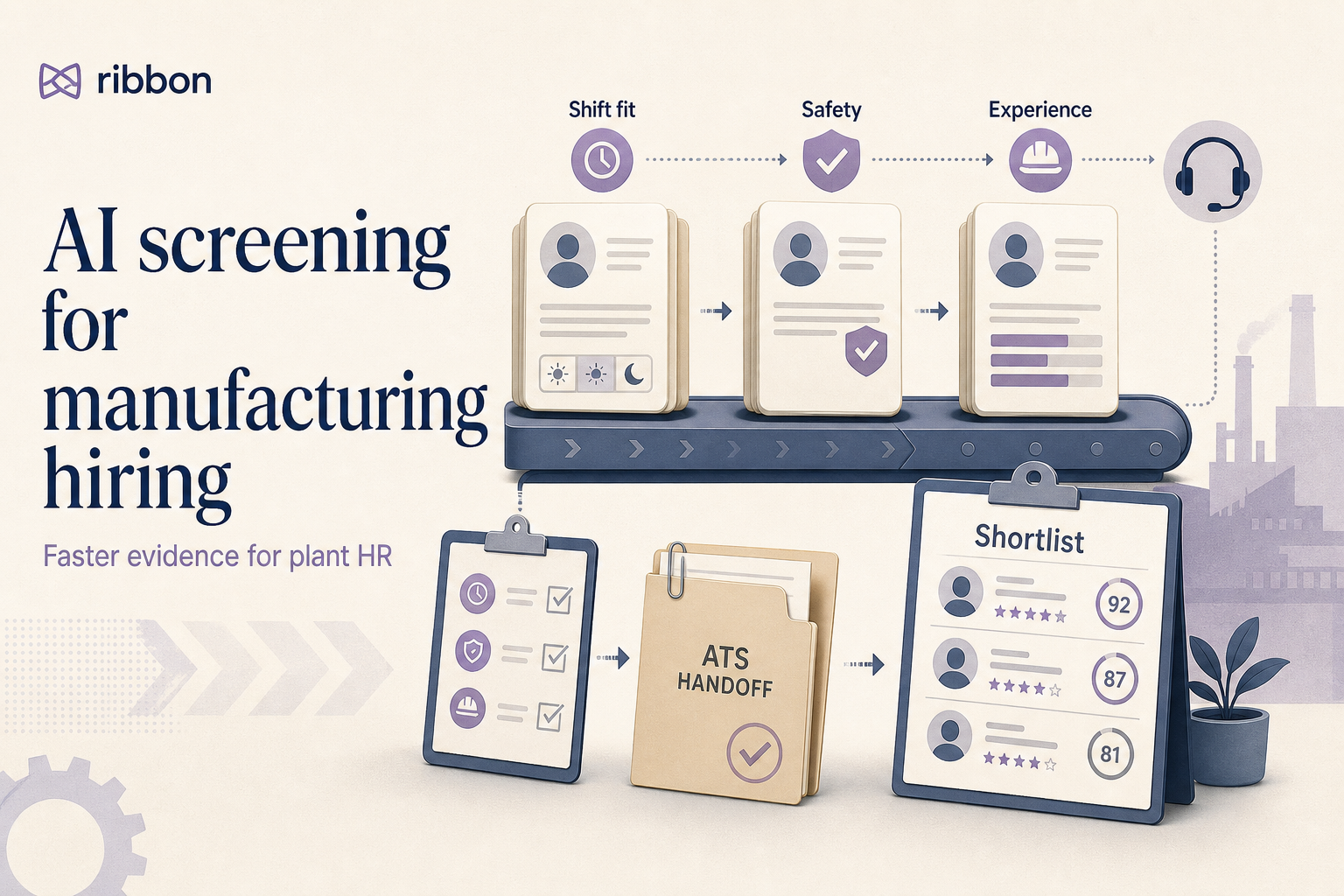
Plant hiring goes sideways when second-shift applicants wait for morning callbacks. This guide shows what manufacturing teams should expect from AI screening: ATS-centered handoff, reviewable evidence, human judgment, and a pilot scope that does not create cleanup work.
Lorem ipsum dolor sit amet, consectetur adipiscing elit, sed do eiusmod tempor incididunt ut labore et dolore magna aliqua. Ut enim ad minim veniam, quis nostrud exercitation ullamco laboris nisi ut aliquip ex ea commodo consequat. Duis aute irure dolor in reprehenderit in voluptate velit esse cillum dolore eu fugiat nulla pariatur.
Block quote
Ordered list
Unordered list
Bold text
Emphasis
Superscript
Subscript
Manufacturing hiring usually does not break in the sourcing channel. It breaks at the handoff between an application and the first real screen. A machine operator applies after second shift. A maintenance tech replies on a Saturday. A plant HR lead plans to call back in the morning, then the line goes short and the day disappears.
That is the operating problem worth solving. If an AI screening tool cannot reach applicants when they are actually free, capture the details plant teams need, and hand the results back into the ATS without another cleanup step, it is just another dashboard. If it can do those things, it buys real time for recruiters, supervisors, and plant HR.
Ribbon's manufacturing page and its warehousing page both make the same point in plain language: high-volume industrial hiring moves after hours, across shifts, and under throughput pressure. The public site promises 24/7 interviews, 10+ languages, ATS-connected review, and scored candidate packets. The local product surface shows the quieter parts that make those claims believable: job-and-stage selection for ATS workflows, candidate import paths, transcript and recording review, custom scoring, follow-up questions, and downloadable summaries.
That is the standard I would use when evaluating AI screening for a plant or warehouse operation. Not whether the interview sounds clever. Whether the workflow is useful on a busy Tuesday when a shift still needs coverage by dawn.
Plants and distribution sites often have more applicant interest than review capacity. The problem is not a lack of names in the funnel. It is that the main qualifiers come early and repeat constantly: shift availability, safety basics, certifications, physical requirements, prior equipment experience, commute reality, and language comfort on the floor.
Ribbon's current manufacturing page is sharp on that point. It talks about second-shift applicants, multilingual screening, safety basics before day one, and scorecards that reach plant HR before the morning meeting. The warehousing page uses the same pattern for peak and last-mile hiring: the best candidates apply at night, disappear fast, and should not wait for office hours. That is exactly where AI screening can help. It handles the repetitive first pass at applicant speed instead of recruiter speed.
Manufacturing teams should expect that kind of specificity from any serious tool. If a vendor cannot explain which repetitive checks belong in the first screen and which should stay for a human conversation later, they are selling a category story, not a workflow.
The safest buying assumption is simple: if the ATS falls out of the loop, the rollout will create more work than it removes. Recruiters, plant HR, and site leaders already live in their hiring system. They should not have to reconstruct candidate state from a second inbox.
Ribbon's public site leans hard into that. The homepage calls out two-way ATS integration, and the manufacturing page says scores, transcripts, and recordings land in the ATS for same-day review. The local backend and product surface back that up in practical ways. Recruiters can pull a connected account's jobs and stages, filter or paginate them, import ATS candidates for a selected role or stage, and send outreach after import. That is not flashy. It is the plumbing that decides whether a hiring team trusts the workflow after week one.
This is also where Ribbon's MCP layer matters. In plain English, MCP is the bridge that lets AI agents read recruiting workflow data and act inside the guardrails your team sets. For manufacturing hiring, that matters less as a buzzword and more as an operating rule. The tool should know which role is open, which stage triggered the screen, and where the resulting evidence belongs when the interview ends.
If I were vetting this for a plant environment, I would ask four blunt questions:
Good answers should sound operational, not aspirational.
Plant teams do not need another score with no context. They need a review packet that helps them decide whether to move now, hold, or pass. For industrial hiring, that packet should make it easy to verify shift fit, equipment exposure, reliability, safety awareness, and anything location-specific that affects the first week on the floor.
Ribbon's product surface is strong here. Recruiters can play the recording, inspect the transcript, add transcript-linked notes, download the transcript, download a candidate summary, and review custom scores. The public manufacturing and warehousing pages make the same promise from the buyer side: recordings, transcripts, and scores sit one click away, so a reviewer can make a decision in minutes instead of rebuilding the first screen from memory.
That review packet is where structured interviewing starts to pay off. If you want a companion framework, Ribbon's scorecard guide is useful because it keeps the focus on evidence and role-specific criteria instead of vague thumbs-up or thumbs-down reactions. For plant hiring, that usually means the first screen should answer the operational blockers before it tries to capture culture or long-form career motivation.
A reviewer should be able to glance at the summary, pull the transcript if something feels off, check the recording when nuance matters, and move the candidate forward without another basic callback. That is the bar.
AI screening should take the repetitive front end. It should not take the final hiring call, and it should not pretend to. In manufacturing, the edge cases are too important. A candidate might clear the first screen and still need a supervisor to judge whether the shop environment is right. A maintenance hire may need a deeper discussion about troubleshooting depth. A union site may have local practices that no generic screen should try to encode.
Ribbon's candidate-facing interview preview and wrap-up flow make that split explicit. Candidates are told the interview will be recorded, and after the session they are told a real recruiter will review the responses. That is the right posture. The AI handles speed and structure. Humans keep judgment, exceptions, and accountability.
Trust questions also have to be answered before rollout, not after. Ribbon's manufacturing and warehousing pages both point buyers to Integrity Monitor, the Local Law 144 bias audit, and the regulations material around GDPR and CCPA. The local product surface adds more of the real-world controls teams ask about later, including recording review, access-scoped sharing, and downloadable evidence. Manufacturing teams should expect that mix: candidate notice, reviewable artifacts, and a clear answer to who can open what.
The worst rollout pattern is trying to cover every plant, every role, and every exception path at once. Start with one role family where the first-screen bottleneck is obvious. Machine operators, assemblers, forklift operators, quality roles, and shift supervisors often fit because the first questions repeat and the cost of delay is easy to see.
Ribbon's rollout checklist and high-volume hiring metrics guide are good reminders here. Measure time to first completed screen. Measure how many applicants are screened before the next business day. Measure reviewer time per candidate. Measure shortlist quality. Measure how often talent ops still has to clean up the ATS handoff. Those numbers tell you whether the workflow improved. Raw interview count does not.
I would keep the first pilot narrow: one ATS path, one plant or site group, one review owner, and one scorecard that reflects the actual role. If the review handoff feels boring after that, good. Boring means the right information showed up in the right place, with no mystery and no heroics.
Start with roles that get steady applicant volume and rely on a repeatable first screen. That is usually where speed and structure matter most.
No. It should replace repetitive first-pass screening and give reviewers better evidence. The hiring decision should still sit with people.
Not always. Ribbon's public manufacturing and warehousing pages both describe phone or video interviews, which is useful for shift-based applicants who may not be sitting at a laptop when they apply.
Consent language, access to recordings and transcripts, retention expectations, bias-review material, and the exact ATS handoff. Those are the controls that turn a pilot into an approved workflow instead of an exception request.
Manufacturing hiring teams should expect AI screening software to do three things well: reach applicants when they are available, capture the repetitive evidence humans need for the first decision, and keep the ATS-centered workflow intact. Everything else is secondary.
Ribbon's public segment pages and local product surface line up around that standard more than most category copy does. The promise is not magic. It is that second-shift applicants can be screened before the morning meeting, that reviewers get a packet they can actually use, and that plant hiring can move faster without loosening accountability.
That is a practical expectation. It is also the only one that matters once the floor is short-staffed and the next shift starts in a few hours.
Natural-sounding AI interviews that candidates actually enjoy
Instant feedback and scoring for every candidate
24/7 availability. Never lose a candidate to scheduling delays

"Ribbon AI reduced our time-to-hire by 60% while improving candidate experience."
- Sarah M., Head of Talent
See why teams are switching to smarter hiring.
7-day free trial • Cancel anytime


