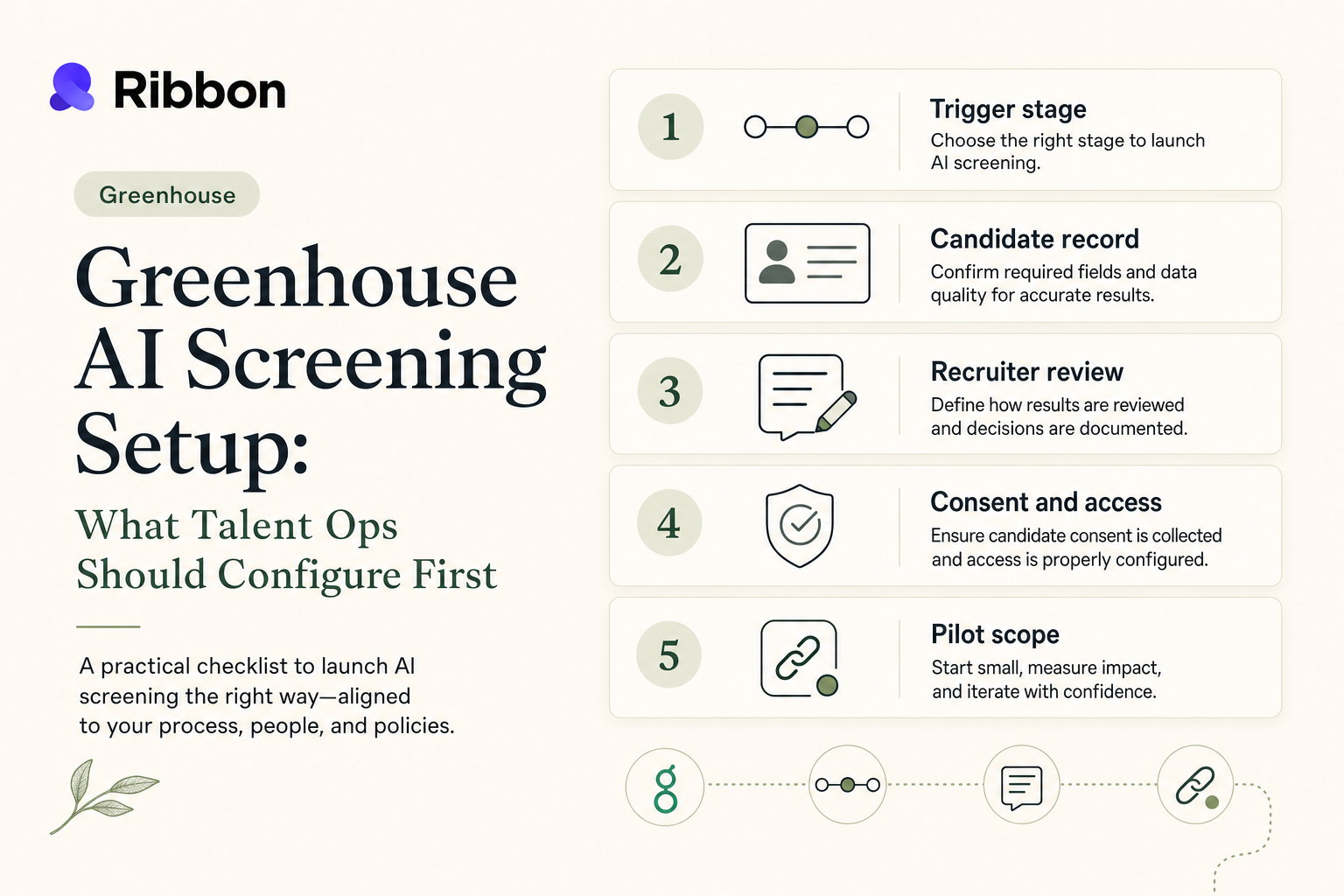
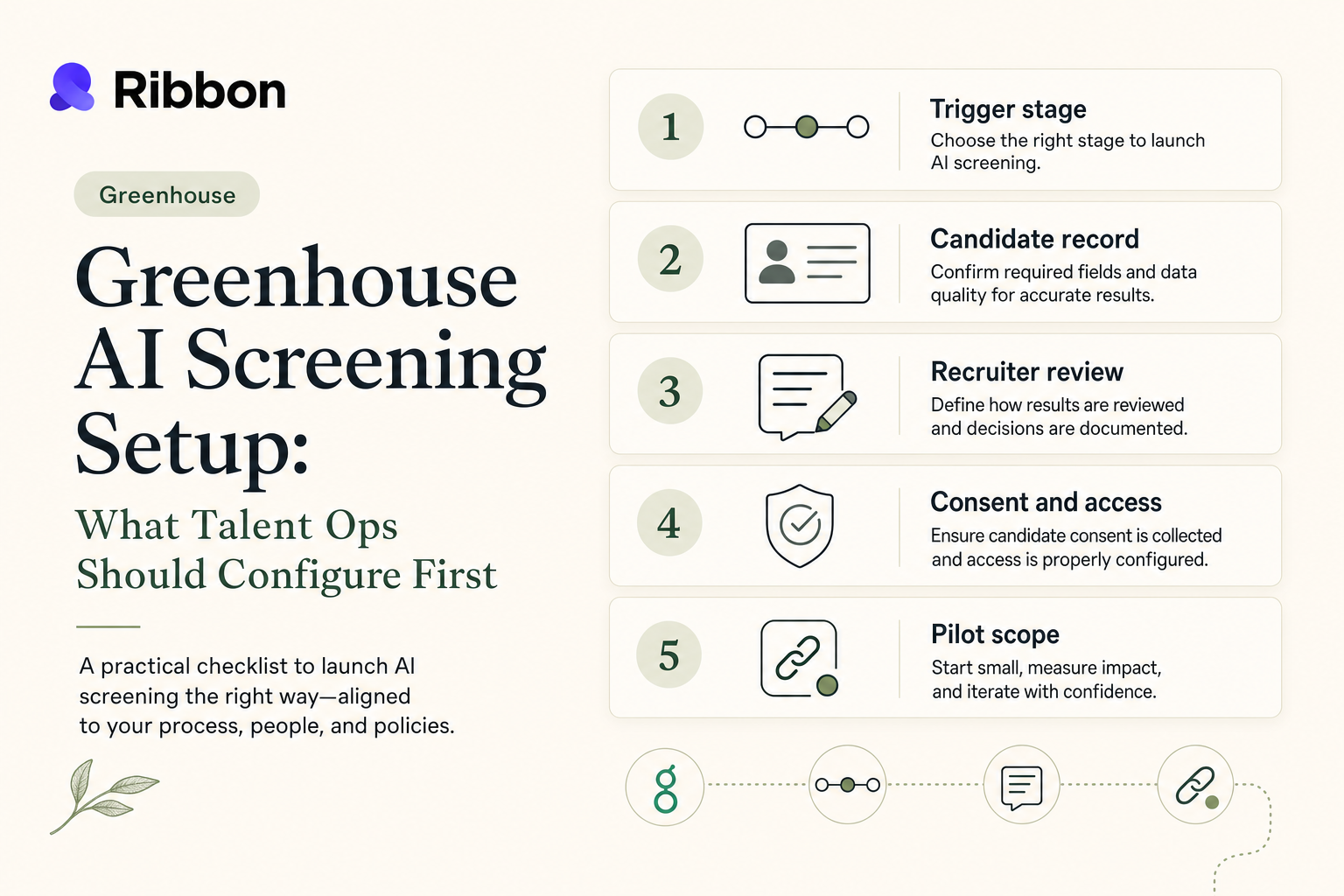
Greenhouse rollouts get messy when the trigger stage, recruiter handoff, and review packet are left vague. This checklist shows talent ops teams how to set up AI screening so candidate records stay clean, reviewers get usable evidence, and the pilot does not create extra cleanup work.
Lorem ipsum dolor sit amet, consectetur adipiscing elit, sed do eiusmod tempor incididunt ut labore et dolore magna aliqua. Ut enim ad minim veniam, quis nostrud exercitation ullamco laboris nisi ut aliquip ex ea commodo consequat. Duis aute irure dolor in reprehenderit in voluptate velit esse cillum dolore eu fugiat nulla pariatur.
Block quote
Ordered list
Unordered list
Bold text
Emphasis
Superscript
Subscript
Greenhouse usually is not the hard part of an AI screening rollout. The hard part is deciding exactly where the interview should start, what evidence should come back, and which parts of the workflow still belong to a recruiter. If those choices stay fuzzy, the pilot feels impressive in a demo and annoying in production.
That is why I would treat a Greenhouse launch as a workflow design job, not a feature toggle. Greenhouse already gives teams a clean model to work with: jobs, candidates, applications, job stages, notes, and activity history. Ribbon's Greenhouse integration page stays close to that structure. It says teams can choose which jobs and pipeline stages trigger a Ribbon interview, send candidates an interview link as soon as they apply or hit a screening stage, and write the result back to Greenhouse with a summary, transcript, scores, and a recording link on the candidate record.
The official Greenhouse docs matter here because they tell you what the ATS itself calls things. Applications sit between candidates and jobs. Job stages are tied to a given job. Greenhouse also exposes the candidate activity feed, which includes interviews, notes, and emails. If talent ops keeps those objects straight from the start, the rollout gets easier to reason about.
Here is the checklist I would use before turning on AI screening in Greenhouse.
Start with the moment that should launch the screen. Greenhouse supports a New Candidate Application webhook event, and Ribbon's Greenhouse page says the interview can start when a candidate applies or when they reach a chosen screening stage. Those are not the same operating choice.
If you trigger on application, you maximize speed. That works well for roles where almost every applicant should get the same first pass. If you trigger on a later stage, you keep more recruiter control. That is usually better when a coordinator still needs to do a quick eligibility check before the interview goes out.
What matters is consistency. Pick one trigger rule per pilot role family, document it, and avoid mixing application-based and stage-based launches for the same role until the team knows which path it wants to keep.
I would also name the owner of that rule. Someone has to decide when a stage change means "send the interview now" and when it does not. If nobody owns that decision, talent ops ends up debugging edge cases by reading activity logs after the fact.
The fastest way to lose recruiter trust is to make them leave Greenhouse to reconstruct the first screen. Ribbon's Greenhouse page is refreshingly specific here. It says the write-back includes a recording link, a tight summary, a transcript, and scores against your criteria.
That is a good baseline, but talent ops should still define the minimum review packet in plain language:
Greenhouse's own model helps here. The platform has candidate notes, application records, and an activity feed. Use that reality. Do not design a side workflow that asks recruiters to remember which facts live in Greenhouse and which live somewhere else.
If I were running the pilot, I would set a blunt standard: a recruiter should be able to open the candidate record in Greenhouse and know, within two minutes, whether to advance, hold, or pass. If that is not possible, the write-back is still too thin.
Ribbon's privacy policy is clear that Ribbon does not make autonomous hiring or employment decisions. That line should show up in the rollout design, not just in legal copy.
The AI should handle the repetitive first pass. Humans should still decide whether the candidate moves forward. In practice, that means reviewers need evidence, not just an output label. Greenhouse is a strong place to do this because the team already reviews candidate history there, and the activity feed gives one timeline for notes, emails, and interview-related activity.
Set the review rule early. For example: every completed interview gets a recruiter review in Greenhouse before any manual or automated stage move beyond the screening checkpoint. If the team wants to auto-advance or disposition candidates later, do that only after it has real pilot data and clear exception handling.
This is where a lot of rollouts get ahead of themselves. They automate the easy part first, then realize nobody agreed on who checks the borderline candidates. Keep the decision loop human while the workflow is still settling down.
Do not wait for legal or IT to raise these questions after the first interviews run. Ribbon's regulations page says recording interviews requires a lawful basis, most commonly explicit consent, and that teams need transparency, access controls, and retention policies. Ribbon also says its consent flow captures explicit candidate agreement before recording.
That gives talent ops a concrete checklist:
None of this is glamorous, but it saves time later. The better the rollout goes, the faster these questions arrive from security, privacy, or procurement. You want the answers ready before the workflow becomes popular.
Greenhouse makes it tempting to wire up several jobs at once because the structure already exists. Resist that urge. Start with one role family, one trigger rule, one review owner, and one write-back pattern.
For example, if the pilot is for customer support hiring, keep it to the Greenhouse jobs and stages that already follow the same review pattern. If the pilot is for agency recruiting, keep it to one client workflow instead of trying to normalize every variation on day one.
The goal is not to prove that AI screening can run everywhere. The goal is to prove that one Greenhouse-centered workflow stays clean from application to review. Once that works, expansion gets easier because the team is copying a pattern instead of inventing a new one.
Choose based on control versus speed. Apply is faster. A later stage gives recruiters a manual checkpoint before the interview goes out.
Usually it is the summary, transcript, scores, and recording link that Ribbon says it writes back to Greenhouse. The right answer is whatever lets a reviewer act without hunting for context.
Not on day one unless the team has already agreed on the review rule and the exception cases. Start with human review first. Add automation after the pilot shows where it is safe.
Time to first completed screen, recruiter review time, completion rate, how often reviewers open the transcript or recording, and whether the Greenhouse record is complete enough for the next decision.
The best Greenhouse setup does not feel like a second system that recruiters have to babysit. It feels like the same hiring workflow, just faster at the top of the funnel and better documented when the first screen ends.
If talent ops picks the trigger point carefully, defines the review packet, keeps human judgment in the loop, and settles consent and access early, Greenhouse can stay exactly where it should stay: at the center of the hiring workflow, not at the edge of it.
That is the standard worth chasing. Not "did the AI interview run?" but "did the right evidence land in the right Greenhouse record, for the right reviewer, at the right time?"
Natural-sounding AI interviews that candidates actually enjoy
Instant feedback and scoring for every candidate
24/7 availability. Never lose a candidate to scheduling delays

"Ribbon AI reduced our time-to-hire by 60% while improving candidate experience."
- Sarah M., Head of Talent
See why teams are switching to smarter hiring.
7-day free trial • Cancel anytime


