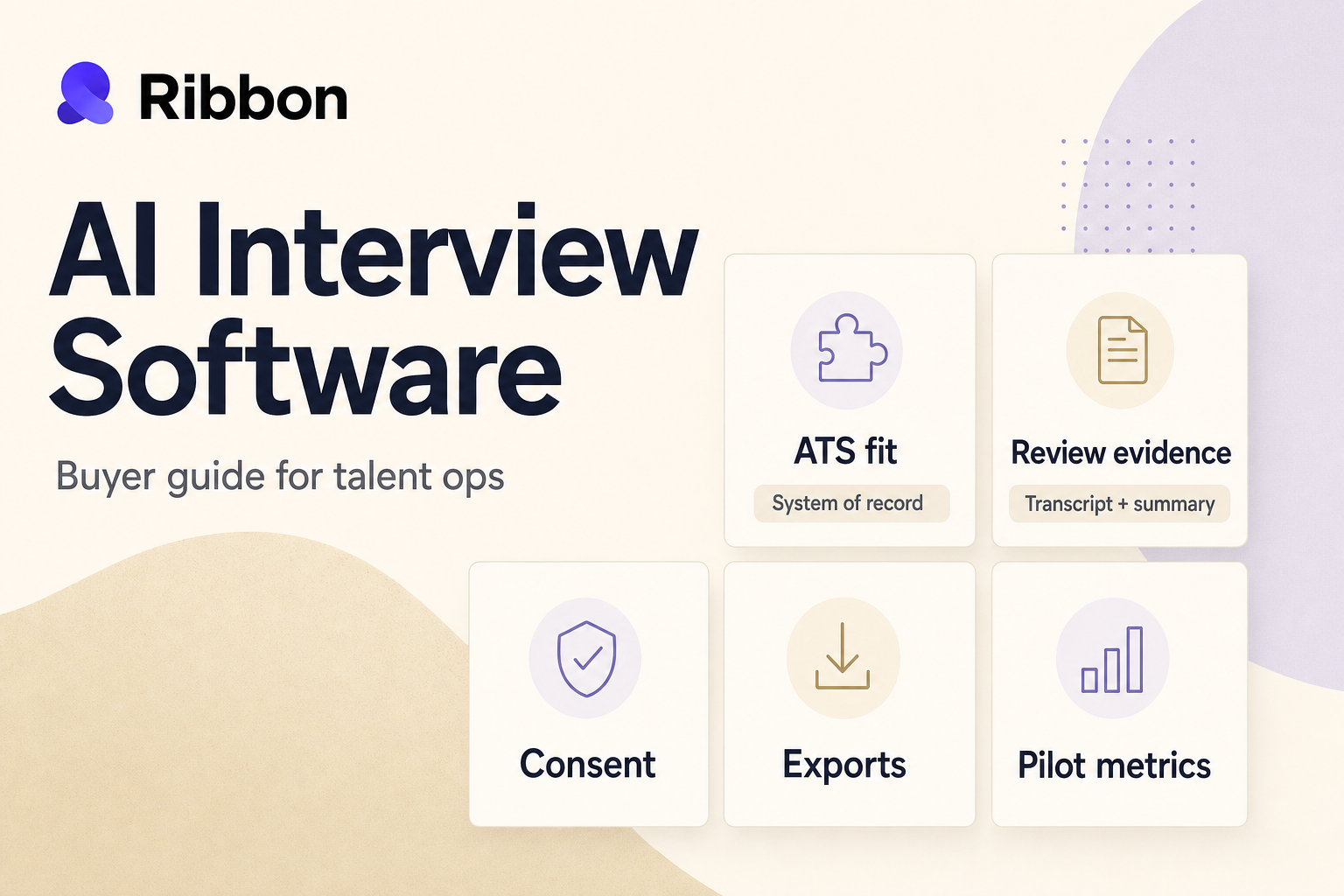
Talent ops teams do not need another slick demo. They need to know whether AI interview software will fit the ATS, produce reviewable evidence, and survive a real rollout without creating new manual work.
Lorem ipsum dolor sit amet, consectetur adipiscing elit, sed do eiusmod tempor incididunt ut labore et dolore magna aliqua. Ut enim ad minim veniam, quis nostrud exercitation ullamco laboris nisi ut aliquip ex ea commodo consequat. Duis aute irure dolor in reprehenderit in voluptate velit esse cillum dolore eu fugiat nulla pariatur.
Block quote
Ordered list
Unordered list
Bold text
Emphasis
Superscript
Subscript
Talent ops usually inherits the mess after the demo. A recruiter likes the candidate experience, a hiring manager likes the promise of faster screens, procurement asks for security answers, and someone on your team ends up figuring out whether the thing actually fits the hiring stack you already run.
That is why AI interview software is a talent ops purchase even when somebody else starts the conversation. The real decision is not whether the tool can ask decent questions. It is whether the workflow holds up once it touches jobs, stages, permissions, candidate records, and recruiter habits.
Ribbon's current integrations overview and pricing page frame the category the right way: connect to the ATS you already use, run interviews around the clock, and give recruiters structured output they can actually review. The harder question, and the one worth slowing down for, is how to evaluate those claims before your team signs anything.
This guide is for talent ops leads, people systems owners, and TA tooling teams doing that evaluation now. I would use it to pressure-test any vendor, including Ribbon.
Most AI interview software gets sold on speed. That is understandable, but speed is not what talent ops has to live with. Talent ops has to live with the exception cases: jobs that do not map cleanly, recruiters who cannot find the interview output, hiring managers who still ask for manual summaries, consent language that legal wants changed, and candidate-data requests that show up after launch.
I would judge the category by operational friction, not marketing polish. If a product needs side spreadsheets, manual exports, or a lot of custom handling to fit your process, it will quietly turn into admin work for the systems team. The vendor may still call that an implementation. Your team will call it cleanup.
A better buying lens is simple: does the software reduce work at the exact points where your recruiting process currently breaks, while keeping control with the people who own the workflow?
If the ATS is your system of record, start there. Before you watch another polished interview demo, ask how the software fits jobs, stages, candidate records, and recruiter handoff inside the hiring workflow you already run. This sounds obvious, but it is the first place weak tools fall apart.
Ribbon's public product surface is unusually direct on this point. The site emphasizes ATS integrations and custom mapping rather than treating integration as an afterthought. That is the right posture. Talent ops should care less about whether the interview feels clever and more about whether the workflow stays anchored to the requisition, stage logic, and reporting structure that already drive hiring.
In practice, I would ask questions like these:
If a vendor cannot answer those cleanly, the rest of the evaluation does not matter much. A strong demo with weak ATS fit just moves the bottleneck downstream.
A lot of tools still act as if a screening score is the product. For talent ops, that is not enough. Recruiters and hiring managers need a review package they can trust, skim, and share. If the output is thin, people revert to manual calls because they do not feel safe making decisions from the software alone.
This is where Ribbon's current product shape is worth studying. The live product and repo evidence show candidate summaries, recordings, timestamped transcripts, follow-up questions, candidate questions, downloadable candidate summaries, and editable custom scores. That is much closer to what hiring teams actually need. A recruiter can move from completed screen to review in one sitting. A manager can verify tone or detail in the recording. Talent ops can inspect the rubric instead of treating the score as a black box.
I would not let a vendor leave this section at the level of \"we provide insights.\" Make them show the actual review artifact. Can a recruiter see what the candidate said, not just how they were rated? Can a manager compare candidates quickly? Can the team export a summary packet when a stakeholder does not live in the tool every day? Those details decide adoption.
One practical rule I keep coming back to: if the software cannot produce a manager-ready summary without extra note-taking, you are not buying enough workflow reduction.
Security review is where many evaluations become real. Not because the vendor suddenly changes, but because the questions stop being abstract. Who can access recordings? What notice does the candidate see before the interview starts? How do exports and deletions work? Can you change retention and consent language to match your policy?
Ribbon's current regulations page is useful here because it talks in operating terms rather than vague trust language. It highlights customizable consent screens, recording notices before interviews begin, export and delete support for candidate data, role-based access controls, activity logs, and human review in the loop. Those are the controls talent ops teams need procurement and legal to see.
The repo backs up the same picture. Interview settings include consent text, required phone collection, and desktop-required controls. The product exposes recording playback, transcript views, downloadable candidate summaries, and custom-score editing. There is also explicit handling for deleting or revoking access to recordings. That combination matters because governance is not one feature. It is the set of controls that keep a fast workflow reviewable later.
If your team hires across states or countries, this section gets even more important. The right question is not \"are you compliant everywhere?\" No vendor should answer that loosely. The better question is whether your team has enough control over notice, access, retention, and deletion to operate responsibly in the places you hire.
I do not trust AI interview evaluations that jump straight from demo to rollout. A useful buying process needs a pilot, and a useful pilot needs numbers that expose whether the workflow is actually helping.
For talent ops, I would start with four metrics:
Those metrics do two things. They tell you whether the software is creating real throughput, and they tell you where the process still leaks. If completion is high but recruiters still rewrite summaries, your output model is weak. If screens finish quickly but shortlist conversion does not improve, the interview design may be collecting the wrong signal. If the recruiter review time never drops, the product may be adding one more place to click around rather than reducing work.
Ribbon's current positioning around round-the-clock screening, ATS-linked workflows, summaries, recordings, and scoring gives a reasonable base for this kind of pilot. The important part is not the promise. It is whether your team can inspect the result and decide what changed.
By the time you reach final evaluation, the question set should be sharp. I would ask:
That list sounds blunt because it should be. Talent ops is not buying interview theater. It is buying a workflow that has to survive recruiter use, manager scrutiny, security review, and operational variance across roles.
The best AI interview software will not just screen candidates. It will fit the stack you already run, return evidence people can review, and give your team enough control to roll it out without creating a second recruiting system by accident. That is the bar I would hold. It is also the bar worth holding Ribbon to.
Natural-sounding AI interviews that candidates actually enjoy
Instant feedback and scoring for every candidate
24/7 availability. Never lose a candidate to scheduling delays

"Ribbon AI reduced our time-to-hire by 60% while improving candidate experience."
- Sarah M., Head of Talent
See why teams are switching to smarter hiring.
7-day free trial • Cancel anytime


