Talent ops teams need more than a vendor questionnaire before AI screens go live. This checklist turns compliance questions into operational decisions: access, candidate experience, human review, evidence, and a small, auditable pilot.
Lorem ipsum dolor sit amet, consectetur adipiscing elit, sed do eiusmod tempor incididunt ut labore et dolore magna aliqua. Ut enim ad minim veniam, quis nostrud exercitation ullamco laboris nisi ut aliquip ex ea commodo consequat. Duis aute irure dolor in reprehenderit in voluptate velit esse cillum dolore eu fugiat nulla pariatur.
Block quote
Ordered list
Unordered list
Bold text
Emphasis
Superscript
Subscript
Compliance gets discussed late in too many AI recruiting projects. The pilot is already scheduled, the interview questions are nearly done, and someone finally asks what happens if a candidate needs an accommodation or a hiring manager treats a score as a decision.
That is backwards. The useful compliance work starts with the hiring workflow: what the system asks, what it records, who sees it, and where a person takes responsibility for the next decision. A vendor questionnaire still matters, but it cannot answer those questions for you.
This is a practical checklist for talent ops and people-systems owners evaluating AI screening or structured AI interviews. It is not legal advice. Bring counsel in early, then give them a workflow they can actually review.
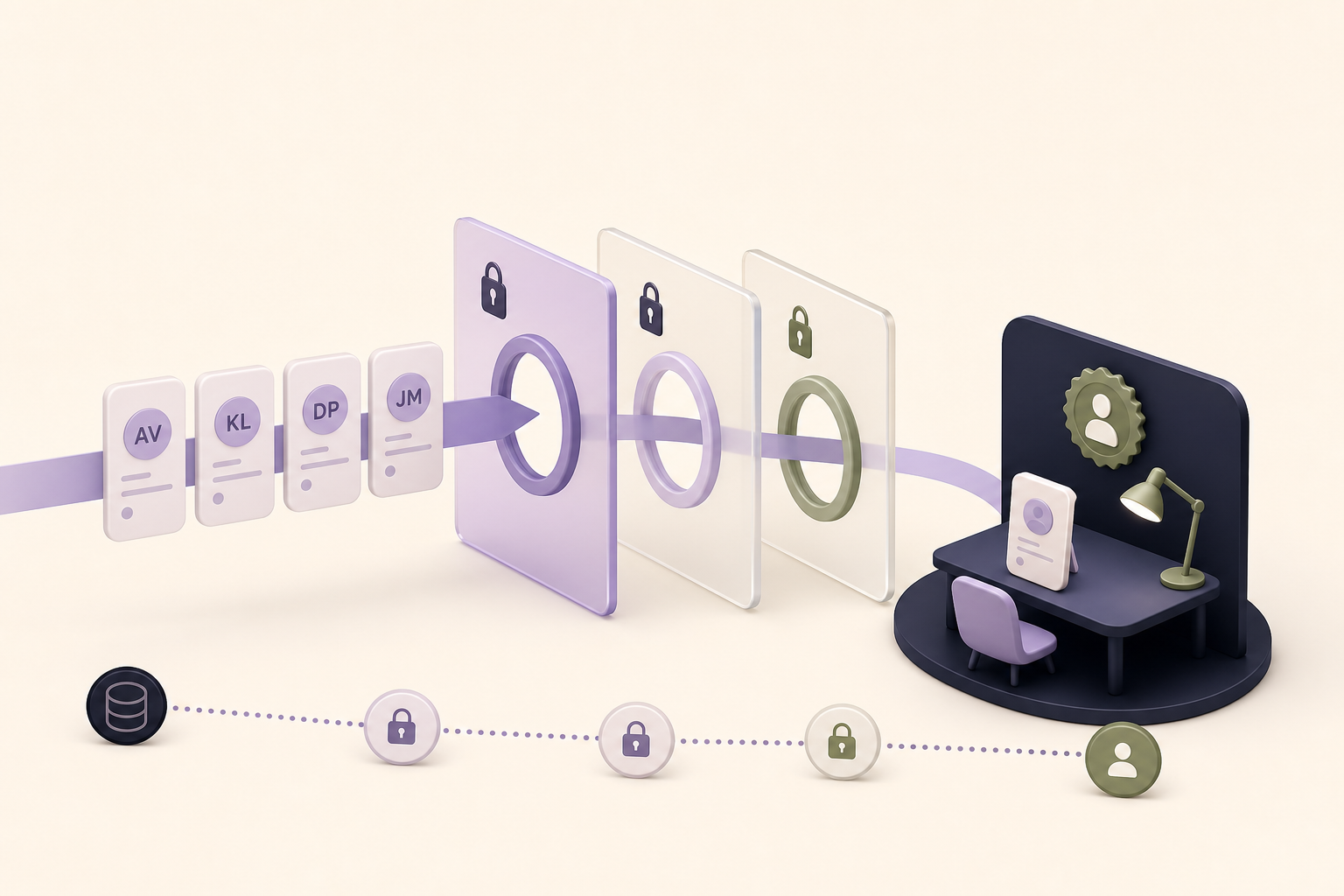
Draw the journey before you buy a tool or approve a configuration. Start at the application trigger and end at the recruiter or hiring-manager decision. Put the candidate's invitation, completion status, interview record, reviewer notes, and disposition on that map. If an interview summary returns to the ATS, mark that too.
Then ask a less comfortable question: where could the workflow surprise a candidate? A late-night invitation with no context is different from a clear explanation of what the screen covers and how long it will take. A failed recording is different from a candidate who needs another way to demonstrate the same job-related capability. Those details are not edge cases. They are the flow.
The EEOC's guidance on employment tests and selection procedures is a useful starting point for U.S. teams. It explains that selection procedures can create legal issues when they intentionally discriminate or disproportionately exclude people in protected groups without a lawful justification. Your counsel decides how that applies to your organization. Talent ops should be able to show them the actual candidate path, rather than a slide called "AI rollout."
AI screening goes sideways when the interview is asked to stand in for a vague idea of "fit." That word causes trouble because nobody can explain what it means after the fact. A better screen asks for evidence tied to the role: schedule availability for a shift-based job, a candidate's experience with a required task, or how they would handle a job-specific scenario.
For each question, record four things: the role requirement it examines, what a good response looks like, what a recruiter should do with a weak or incomplete response, and whether an alternative assessment route is needed. The record does not have to be ceremonial. A shared scorecard is enough if it is specific.
Keep questions proportionate to the first decision. A first screen should not collect a life story. It should help a recruiter decide whether to review the candidate, request more information, or move them to the next appropriate step. That narrower purpose makes the interview easier to explain, easier to test, and easier to improve.
"The hiring team" is not an access policy. Name the groups: recruiters, recruiting coordinators, hiring managers, interviewers, analysts, administrators, and any vendor support role. For each, decide whether the person needs the interview link, transcript or recording, summary, scorecard, status, or none of those things.
Least-privilege access sounds abstract until a candidate asks who viewed their interview. Then it becomes a very practical question. Your system owner should know where permissions are set, how access changes when someone moves teams, and how an offboarded manager loses access. If an AI interview workflow touches the ATS, make the ATS the source of truth for the stage and the people permitted to act on it.
The NIST AI Risk Management Framework is voluntary guidance, not a recruiting rulebook. Its govern, map, measure, and manage framing is still useful here. Map the data and decisions. Set ownership. Measure what can go wrong. Change the workflow when the evidence says you should.
A human reviewer should have more to do than click "approve" on a score. Define the decision they own. They may decide whether the candidate advances, whether a result needs context, whether an accommodation path applies, or whether the screen itself needs revision. The point is to give the reviewer enough information and authority to exercise judgment.
That also means defining what an automated outcome can do. It can invite a candidate, organize structured evidence, or flag a response for review. Do not let a configuration quietly turn a screening score into an automatic rejection unless your organization has deliberately approved that use and can defend it. The same care applies to cutoffs. A number can look objective while hiding a poor question or a bad threshold.
For Ribbon implementations, keep the recruiter review packet and the next ATS action connected to that named human owner. The goal is not to make the recruiter disappear. It is to make the first review less dependent on who happened to be online when the application arrived.
When someone asks why a candidate moved forward or did not, you need more than a memory of the setup meeting. Keep the role scorecard, the approved interview version, the intended trigger, the reviewers with access, and the changes made during the pilot. Match those records to the candidate's ATS stage where possible.
This trail also makes ordinary operations better. If completion falls for one role, you can compare the invitation timing and interview version. If managers override a recommendation often, you can see whether the scorecard missed something they actually need. If a candidate reports a problem, you can identify the workflow version they experienced.
Do not mistake a spreadsheet full of fields for useful evidence. The record should answer plain questions quickly: What was this screen meant to assess? What did the candidate receive? Who reviewed it? What action followed? What changed after we learned something?
Start with a role that has enough volume to learn from but a manageable set of stakeholders. Define a baseline before launch: application volume, time to first completed screen, completion rate, review age, advance rate, and the reasons a recruiter overrides or reopens a result. Do not promise an ROI number before you have those baselines.
Run a short weekly review with talent ops, the recruiter who owns the workflow, and the business lead. Look at candidates who completed, dropped off, needed an alternate path, received a surprising result, or were handled outside the normal route. Those exceptions are where the real implementation choices show up.
Only expand when the team can explain the workflow in a few direct sentences, including who owns it and where human judgment lives. That is a much better readiness test than a green project plan.
AI recruiting compliance is not a document you finish once. It is a set of operating choices you can point to, test, and change. Make those choices early, and your team has a much better chance of building a screen that respects candidates and gives recruiters useful evidence.

Natural-sounding AI interviews that candidates actually enjoy
Instant feedback and scoring for every candidate
24/7 availability. Never lose a candidate to scheduling delays

"Ribbon AI reduced our time-to-hire by 60% while improving candidate experience."
- Sarah M., Head of Talent
See why teams are switching to smarter hiring.
7-day free trial • Cancel anytime


