Most AI recruiting pilots fail at the handoff, not the interview. This post shows talent ops teams why ATS context matters, what the AI should own, and where human review still belongs.
Lorem ipsum dolor sit amet, consectetur adipiscing elit, sed do eiusmod tempor incididunt ut labore et dolore magna aliqua. Ut enim ad minim veniam, quis nostrud exercitation ullamco laboris nisi ut aliquip ex ea commodo consequat. Duis aute irure dolor in reprehenderit in voluptate velit esse cillum dolore eu fugiat nulla pariatur.
Block quote
Ordered list
Unordered list
Bold text
Emphasis
Superscript
Subscript
Most teams do not have an AI problem. They have a context problem.
The first demo usually looks great. An AI interviewer can screen around the clock, ask follow-up questions, and turn a long call into a summary a recruiter can skim in two minutes. Then week three arrives. Results live in a side dashboard, recruiters still have to check the ATS for stage status, and talent ops inherits one more workflow to explain to security. The automation is not broken, exactly. It is just sitting outside the system that already runs hiring.
That is why I think most AI recruiting automation disappoints after the pilot. The issue is rarely the interview itself. The issue is whether the automation can work with the same jobs, stages, candidate records, permissions, and review steps your team already uses. If it cannot, you have not removed work. You have moved it.
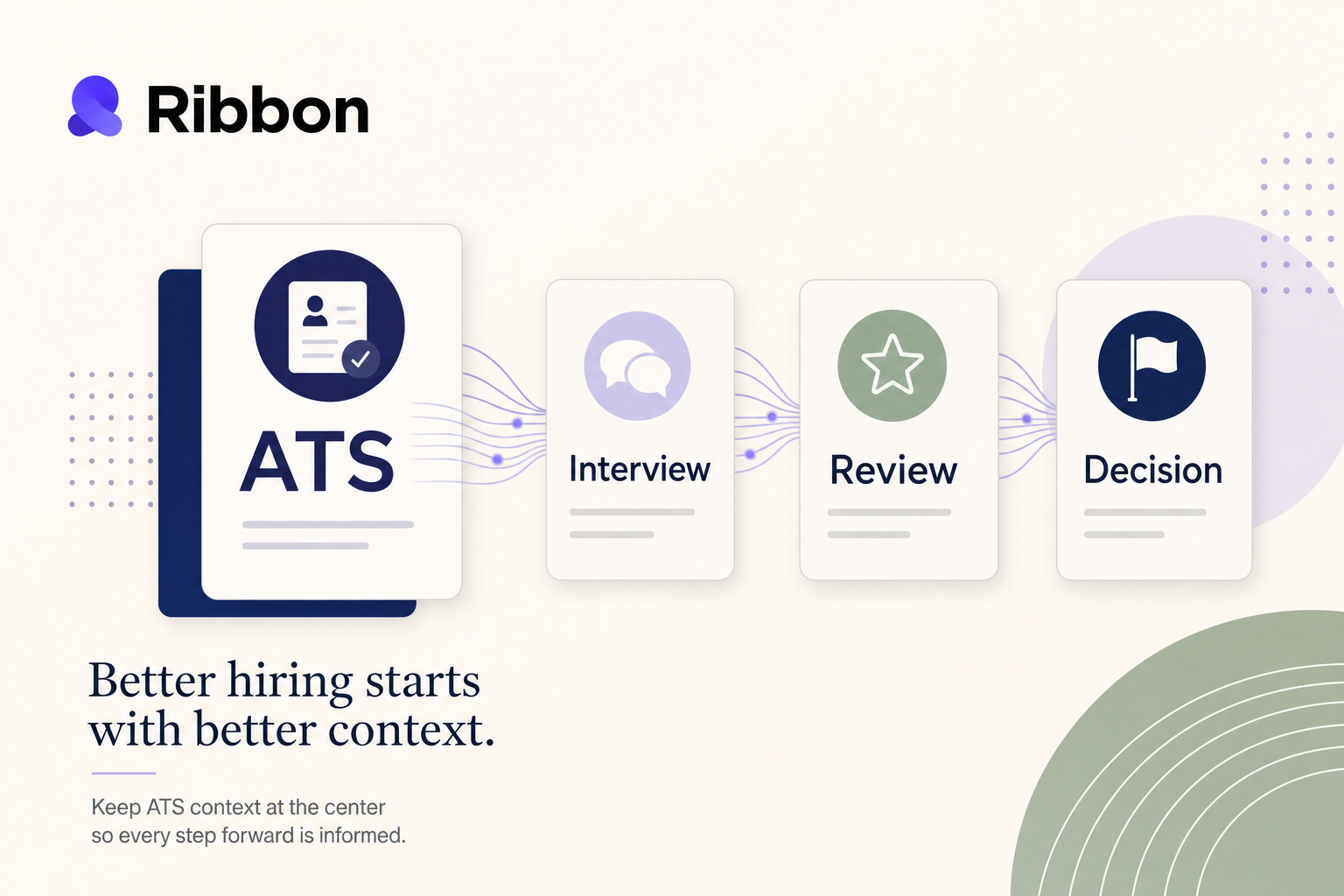
For talent ops teams evaluating AI ATS integration, this is the line that matters. The ATS should remain the operational center of gravity. AI can do the repetitive front-end screening work. It can collect answers at scale, score against consistent criteria, and surface a better shortlist. But the workflow still needs to land back in the record your recruiters trust.
Hiring teams talk a lot about screening speed, and fair enough. In many funnels, the first screen is where backlog starts. Yet the mess usually shows up one step later. Someone has to connect the interview result to the right candidate, the right job, the right stage, and the right reviewer. If that handoff is loose, everything downstream gets worse.
You see it in small ways first. Recruiters copy summaries into notes by hand. Managers ask whether a score came from a phone interview or a live panel. Ops cannot tell whether a candidate is actually waiting on review or just stranded between systems. Security asks who can see recordings, who can export data, and whether the consent flow is consistent across roles.
This is why "AI recruiting automation" is too vague to be useful on its own. The real question is narrower: does the automation reduce recruiter work inside the workflow you already run? If not, your pilot may improve the top of funnel while making the middle of funnel harder to trust.
A good ATS does four jobs that an AI layer should not try to replace.
That does not mean the ATS has to do the interviewing. It means the ATS should remain the system that tells the rest of your stack what is real. When an automation platform ignores that, recruiters end up reconciling two truths: what the AI tool thinks happened and what the ATS says happened. That reconciliation work is exactly what talent ops teams are trying to delete.
Ribbon's own product shape points in the right direction here. The platform has a dedicated integrations layer, interview-flow settings that let teams link an existing ATS account, job, and completion stage, and candidate review tooling that fits around the hiring record instead of asking teams to abandon it.
None of this is an argument against AI interviewing. It is an argument for using it where it has an unfair advantage.
Ribbon's recruiter docs describe a flow that is practical for high-volume or fast-moving teams: create an interview flow for a role, define the questions, apply default or custom scoring criteria, and send a single-use link to each candidate. Teams can also bulk import candidates by CSV when the funnel is too large for manual invites. Candidates complete the interview when it suits them. The hiring team gets a recording, transcript, summary, score detail, and suggested follow-up questions for later rounds.
That is a strong use of automation. The AI handles the repetitive first conversation. It asks the same baseline questions consistently, captures details that matter later, and gives reviewers something more useful than a thumbs up. Ribbon's candidate management docs also show why the review surface matters: teams can compare candidates, cast hire or no-hire votes, export candidate data, and inspect integrity signals when something looks off.
In other words, the AI should do the front-line collection work. Humans should keep the decision rights. And the ATS should keep the process legible.
For talent ops teams, the better model is not "AI instead of ATS." It is "AI with ATS context from the start."
Ribbon's administration docs spell out the basic pattern. First, connect the ATS at the organization level. Then, on each interview flow, choose the connected ATS account, link the flow to the relevant job, and choose the stage used after interview completion. When a candidate finishes, Ribbon can sync interview data back to the candidate profile, and on supported ATS setups it can move the candidate to the stage you configured.
The same principle shows up in Ribbon MCP. MCP is the protocol that lets tools like ChatGPT or Claude read system context from a chat interface. In Ribbon's current product, that ATS chat layer is read-only. Users can ask about open roles, candidates, interviews, and offers without changing the record. I like that constraint. It keeps the conversation grounded in live ATS data while avoiding accidental edits from a chat window. For ops teams, read-only is a feature, not a limitation, when the goal is trustworthy access.
If you want automation that recruiters will keep using after the novelty wears off, this is the shape to look for: structured interview collection in the AI layer, review artifacts that humans can audit, and workflow state that lands back in the ATS.
A lot of buying conversations still treat trust and permissions like a procurement appendix. That is backwards. In hiring, they are part of the product.
Ribbon's interview settings documentation is useful here because it shows the operational details teams eventually need anyway. You can enable a consent screen before the interview starts and customize the text candidates must accept. You can decide whether phone collection is required. You can configure document upload, retry behavior, feedback collection, and redirect rules at the interview-flow level. Those are not nice extras. They are how teams shape candidate experience role by role.
On the review side, Ribbon's candidate management docs describe view and edit access at the interview-flow level, plus exports for transcripts, scores, and candidate summaries. In product code, the candidate detail experience also exposes recordings, transcript playback, custom scores, follow-up questions, and integrity concerns in one place. A recruiter does not need ten tabs open to understand what happened.
If your AI layer cannot answer basic questions about access, consent, review, and export, do not worry about its cleverest features yet. Worry about whether your team will trust the output enough to use it in a real hiring decision.
Every AI recruiting vendor can show a faster interview. That is not the hard part. The hard part is proving that faster interviews produce cleaner pipeline movement and better recruiter time use.
For a real pilot, I would track a short list: time to first screen, completion rate, recruiter review time per candidate, stage movement speed after completion, and the lag between candidate completion and human decision. Then I would check whether those gains are visible in the ATS workflow the team already uses.
This is also where a simple ROI calculator or volume model can help, not as proof by itself, but as a forcing function. How many candidates are you screening per week? How many recruiter hours disappear if the first conversation moves to AI? How much of that time comes back if recruiters still have to re-enter notes or chase context across systems?
My take is simple. Keep the ATS in charge. Let AI do the repetitive work it is actually good at. Demand reviewability, consent controls, and grounded workflow state. If the automation cannot live inside those constraints, it will create more drag than lift.
That is why the future of recruiting automation is not another isolated dashboard. It is an AI layer that can interview well, summarize cleanly, surface signals like integrity monitoring, and still hand the process back to the ATS without drama. That is the version talent ops teams can scale.
Natural-sounding AI interviews that candidates actually enjoy
Instant feedback and scoring for every candidate
24/7 availability. Never lose a candidate to scheduling delays

"Ribbon AI reduced our time-to-hire by 60% while improving candidate experience."
- Sarah M., Head of Talent
See why teams are switching to smarter hiring.
7-day free trial • Cancel anytime


